ROCm and Resolve on NixOS: a compatibility checklist
A four-layer diagnosis for AMD graphics, OpenCL/ROCm, NixOS packaging and DaVinci Resolve before trying an old workaround.
An old workaround can be perfectly documented and still be wrong for today's GPU, ROCm release or application build. Treat the problem as four separate layers. A failure at one layer is not fixed by adding random packages at another.
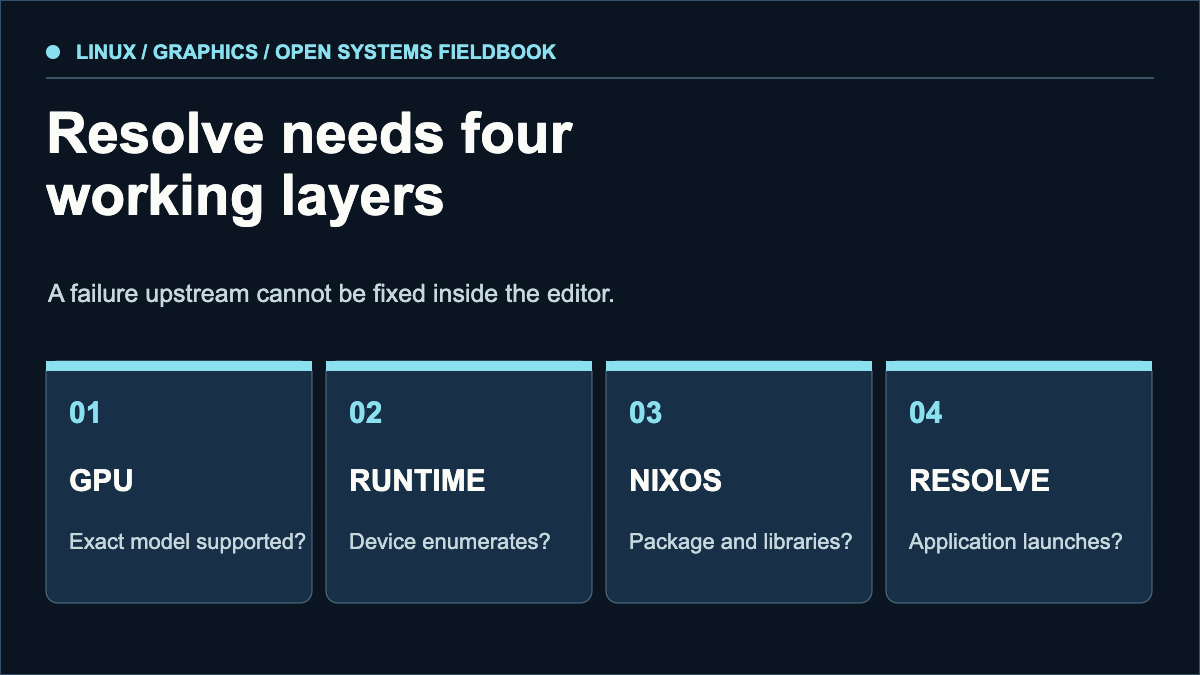
Start with the exact GPU
Record the GPU model and architecture, not just “AMD Radeon.” Compare it with AMD's current ROCm-on-Radeon compatibility matrix for the specific ROCm release. Support varies by GPU, operating system and workload. An RX 580 workaround from a 2024 blog post does not establish support in a current release.
Prove the runtime independently
Before launching an editor, confirm the operating system detects the GPU, the intended driver is active, and the ROCm/OpenCL runtime enumerates a usable device. If enumeration fails, the video editor is not yet the right debugging surface. Preserve the output of diagnostic tools and compare it with the versions you actually installed.
Then inspect the package boundary
NixOS packages and library paths differ from conventional Linux distributions. Review the package expression and its dependencies for your NixOS channel. Keep a record of the system revision so a working setup can be reproduced. Avoid mixing instructions from different NixOS and ROCm releases without checking every option and package name.
Launch only after the lower layers pass
Check the current DaVinci Resolve release notes and Linux requirements. Run the application from a terminal once so missing-library and device messages are visible. If it still fails, report the GPU, kernel, NixOS revision, ROCm version, Resolve version and the exact error. That evidence is far more actionable than “Resolve does not open.”
This path once hosted a hands-on RX 580 configuration. This edition is an original compatibility checklist. It does not claim that a particular GPU and release combination has been tested by this publication.
Sources & scope
These sources support the technical principles above. Commands and compatibility can change; verify the current version before changing a machine.
This is a new, independent edition. Its articles are original editorial work inspired by the domain's technical history; we are not the former author. Meet the author.
One GPU, one release: make the support claim narrow
“ROCm supports my GPU” leaves several different questions unanswered. Write down a specific card, software release, operating system and application before installing packages. The worked record below reads AMD’s versioned ROCm 7.1 Radeon documentation; it is not a claim that 7.1 is the newest release or that DaVinci Resolve was tested here.
- Identify the exact commercial GPU model and the actual device reported by the host. Do not substitute a neighbouring product name or infer support from shared architecture alone.
- Open the versioned vendor matrix for the runtime you intend to use. Save its URL and the date consulted. A search snippet or an unversioned “latest” bookmark is not a reproducible record.
- Check the OS and runtime separately. The example card appears in the hardware list; that does not add NixOS to AMD’s validated operating-system list. Mark an unlisted environment as not vendor-validated rather than as proven broken or proven supported.
- Check the application’s own requirements and the compute API it actually uses. Successful PyTorch execution is not evidence that video decoding, OpenCL or Resolve works. Run a disposable application-specific test before altering the workstation you rely on.
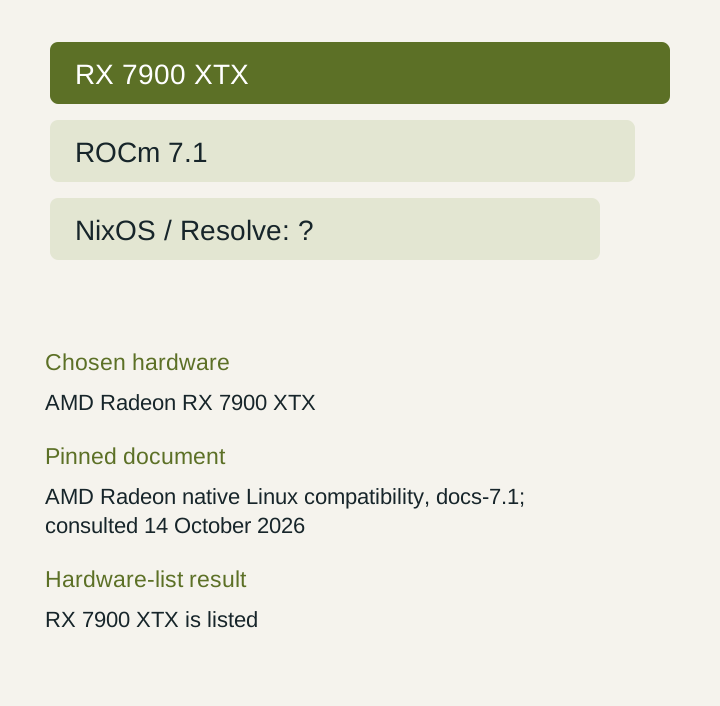
Diagram text: Chosen hardware: AMD Radeon RX 7900 XTX; Pinned document: AMD Radeon native Linux compatibility, docs-7.1; consulted 14 October 2026; Hardware-list result: RX 7900 XTX is listed
| Field | Example or check |
|---|---|
| Chosen hardware | AMD Radeon RX 7900 XTX |
| Pinned document | AMD Radeon native Linux compatibility, docs-7.1; consulted 14 October 2026 |
| Hardware-list result | RX 7900 XTX is listed |
| Proposed host | NixOS: not established as vendor-validated by this matrix |
| Application outcome | DaVinci Resolve: not tested in this release |
| Next evidence to collect | OS/kernel, driver/runtime versions, application version, command/output and a small repeatable task |
Keep “listed hardware”, “validated OS” and “observed application result” as separate fields. When reporting a failure, include the first boundary that fails and the raw error, with private paths removed. Do not install random runtime versions until the evidence record is complete. This matrix-reading exercise adds no GPU benchmark and makes no machine-specific installation claim.
Source context: AMD Radeon: versioned ROCm 7.1 Linux matrix
Keep codec decoding separate from GPU compute
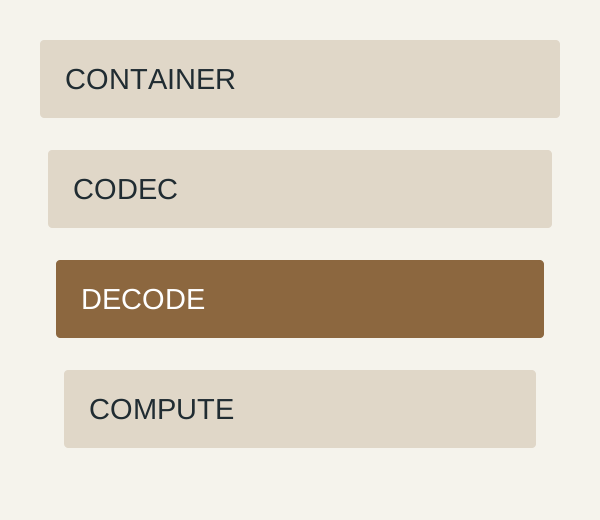
A runtime that recognises a GPU does not establish that an editor can decode a particular clip. Before changing a system, describe the media and the exact application environment. This is an evidence collection procedure; no Resolve or GPU benchmark was run for it.
- Record the application version, edition, operating system, driver and runtime independently. Keep a vendor support statement distinct from a community configuration or a successful local launch.
- Identify one source clip: container, video codec, profile, bit depth, chroma subsampling, resolution, frame rate and audio codec. The filename extension alone is insufficient.
- Check the codec list for that exact application version, operating system and edition. A decode restriction is not resolved merely by passing a compute-library example.
- If you can lawfully test the environment, keep the original clip unchanged and record import, playback and export separately. Without that test, leave every performance field “not measured”.
| Field | Example or check |
|---|---|
| Media identity — fictional record | MOV container; H.264 video; 10-bit; 4:2:2; 3840 × 2160; 25 fps. These are example fields, not a supported-format claim. |
| Decode question | Does this Resolve version and edition on this OS support this codec/profile combination? Save the matching vendor document and its date. |
| Compute question | Which GPU and runtime does the application actually use for effects? Record its own diagnostic, not another program’s GPU detection. |
| Separate observations | Import __; playback __; effects __; export __. Current result for this worksheet: not measured. |
| Next useful request | Send the environment card and a permitted, non-sensitive sample to the relevant support channel; do not publish private source footage. |
This record prevents a codec problem from being reported as proven GPU incompatibility, or a working compute sample from being reported as proven video acceleration.
Sources: Blackmagic Design — official support and versioned documents · AMD — ROCm compatibility documentation